Quartzite in Lahore, Pakistan
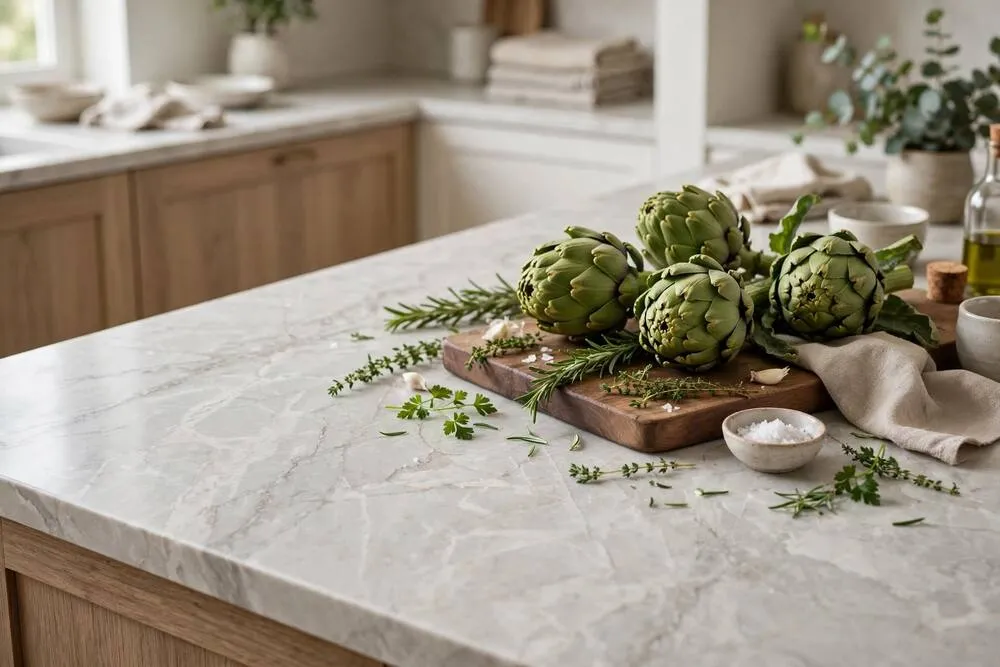
Quartzite is a natural stone that looks like marble but is harder than most granites. It is a top choice for kitchen islands where people want soft veining without the care that marble needs.
| Stone type | Metamorphic: sandstone recrystallised under heat and pressure |
|---|---|
| Main mineral | Quartz (silica) |
| Hardness | About 7 on the Mohs scale, scratches glass |
| Acids (lemon, imli, vinegar) | True quartzite is not etched |
| Heat | Handles hot pans well (a trivet is still wise) |
| Sealing | Yes. Most slabs absorb some oil and need a sealer every 1–2 years |
| Common sources | Brazil, India, Norway, Madagascar |
| Finishes | Polished, honed, leathered |
| Typical thickness | 20 mm and 30 mm slabs |
Ask about Quartzite on WhatsAppVisit the showroom
What is quartzite?
Quartzite starts as quartz-rich sandstone. Heat and pressure over millions of years fuse the sand grains into a dense, glassy rock. Minerals such as iron, mica and chlorite add the grey, blue, gold and green veining that makes slabs look like marble. Every slab is different, so the slab is chosen in person, not from a catalogue picture.
Where quartzite works best
- Kitchen countertops and islands, including heavy desi cooking
- Bathroom vanities and wall cladding
- Feature walls and bookmatched panels
- Table tops and reception counters
- Flooring in honed or leathered finish
Things to know before you buy
- Watch for soft "quartzite". Some slabs sold as quartzite are really dolomite or marble. They scratch and etch. A simple test: a real quartzite scratches a glass tile and a drop of lemon leaves no dull mark.
- Hard to cut. Edges and sink cut-outs take longer than granite, so fabrication costs more.
- Seal it. Lighter quartzites can take an oil or haldi stain if left unsealed.
- Not the same as quartz. Quartz is engineered from crushed stone and resin. Quartzite is 100% natural rock.
Alternatives we stock
If you want the look of white marble with less care, compare quartzite with our engineered quartz (uniform, no sealing) and with light granites such as Kashmir White.
Quartzite FAQs
Is quartzite better than granite for a kitchen?
Both are hard natural stones that suit kitchens. Quartzite is usually harder and has softer, marble-like veining. Granite is easier to cut and usually costs less. For heavy daily cooking either works if sealed.
Does quartzite stain?
It can absorb oil or haldi if it is not sealed, especially the lighter colours. Seal it after installation and every 1–2 years, and wipe spills quickly.
Quartz or quartzite: which is which?
Quartz is an engineered slab made from crushed quartz and resin. Quartzite is a natural metamorphic rock. Quartzite handles heat and sunlight better. Quartz needs no sealing and has a more uniform look.
How can I tell real quartzite from marble?
Real quartzite scratches glass and is not dulled by lemon juice. Marble and dolomite are softer, are scratched by a steel knife and etch with acids. Ask for a sample and test it.
Can I get quartzite in Lahore?
Yes, on order. Send us your counter size or drawing on WhatsApp and we will share the slabs available and a rate.
Other stone guides: Soapstone · Slate · Limestone · All stone FAQs