Stone Cladding Hardware Explained: Anchors, Dowel Pins, Clamps and Brackets
When marble or granite hangs on a wall, small pieces of steel do all the work. Using the wrong ones, or the wrong grade, is the most common cause of cracked and falling cladding.
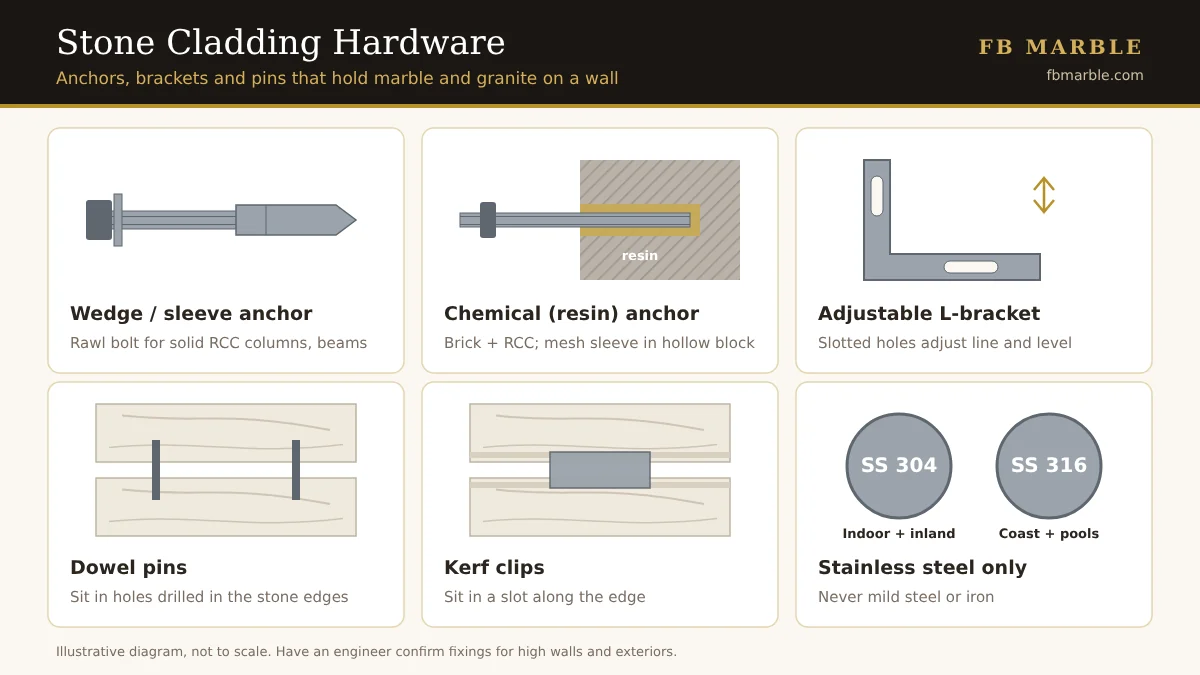
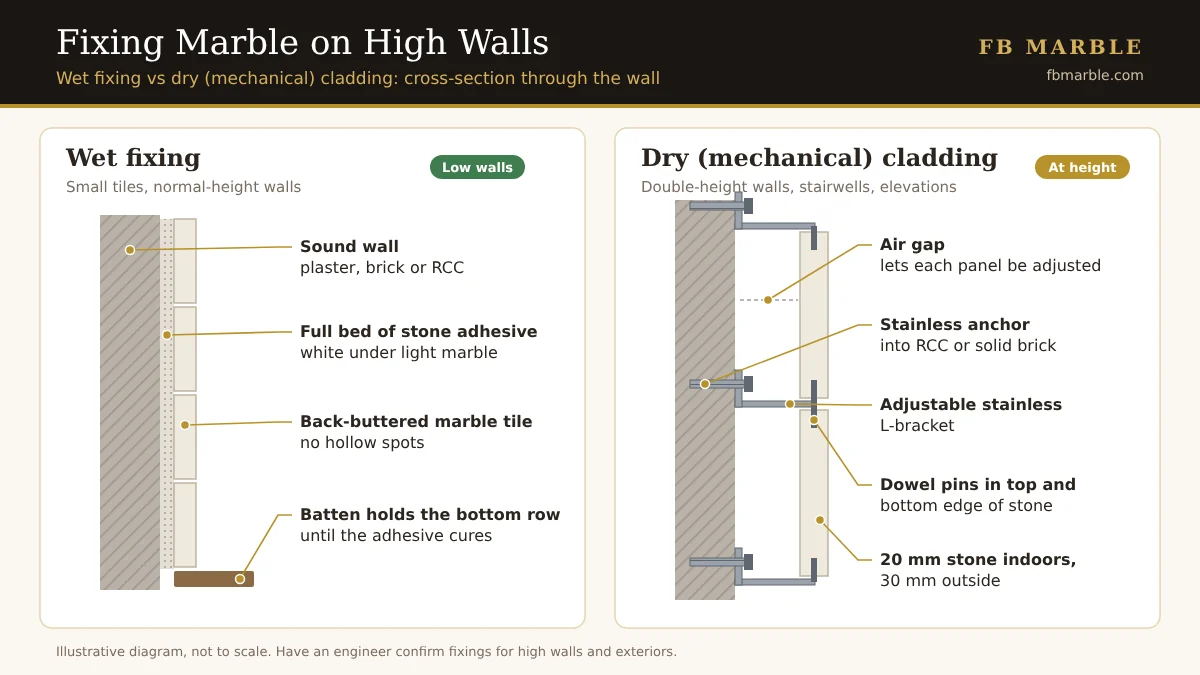
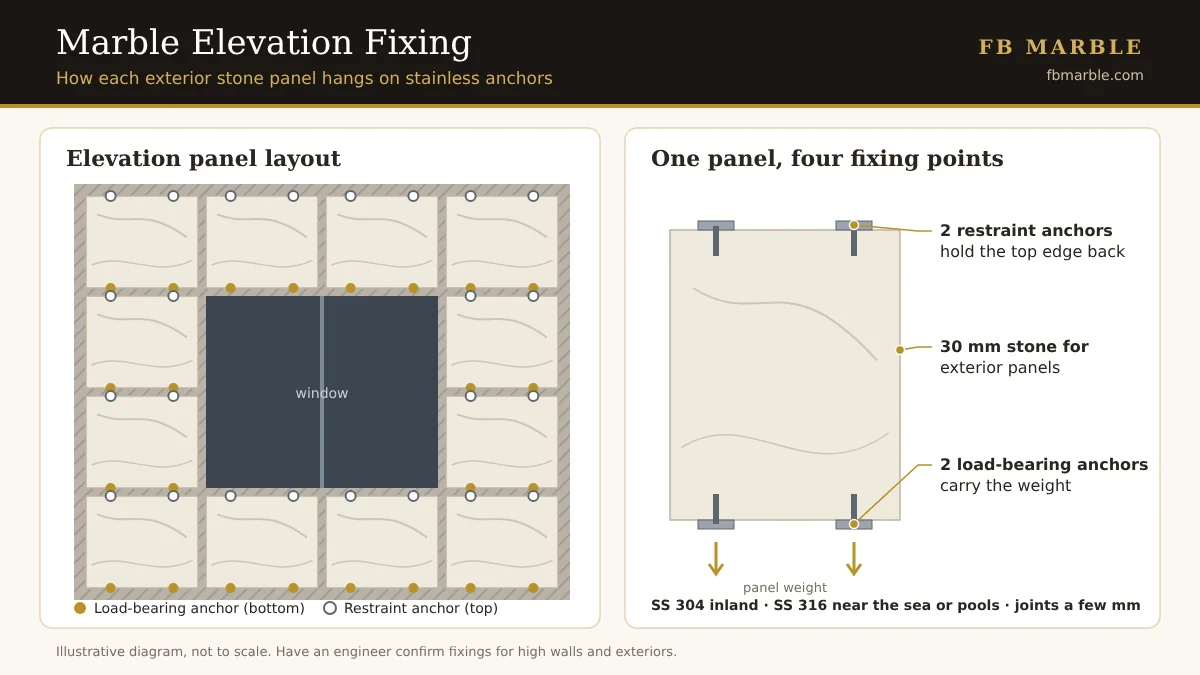
Every dry-cladding system has two parts: an anchor into the wall, and a connection into the stone. Between them sits an adjustable bracket so each panel can be set to line and level. When marble or granite hangs on a wall, these small pieces of steel do all the work. This guide explains what each piece does, which grade of steel to ask for in the market, and the steps to check before any stone goes up.
What you need to know first
- What the wall is made of: RCC, solid brick, hollow block or a steel frame.
- Whether the wall is indoors, an inland exterior, or near the sea, a pool or chlorine.
- The stone, its thickness and the size of each panel.
- Whether an engineer has designed the fixings for exterior or high work.
Step 1: Choose the anchor into the wall
| Anchor | Use it in | Notes |
|---|---|---|
| Mechanical expansion anchor (sleeve or wedge anchor, "rawl bolt") | Solid RCC columns, beams and slabs | Expands inside the hole; needs solid concrete and correct edge distance |
| Chemical (resin) anchor with threaded rod | RCC and solid brick | Resin bonds the rod in the hole; strong in brick where expansion anchors crack it |
| Chemical anchor with mesh sleeve | Hollow block and perforated brick | The sleeve stops resin running into the hollows |
| Through-bolt or embedded plate | Steel frames or new construction | Planned with the structure |
Plaster is not a fixing surface. Anchors must reach the concrete or brick behind it. On weak or hollow walls, a separate steel sub-frame fixed to columns and beams is often safer.
Many houses combine RCC columns and beams with brick or block infill between them. Where possible, place anchors in the RCC, and use chemical anchors where they must go into the brick. Drill a test hole first if you are not sure what is behind the plaster.
Step 2: Choose the connection into the stone
- Dowel pins: short stainless rods that sit in holes drilled into the top and bottom edges of the stone. The simplest and most common.
- Kerf clips: flat stainless plates that sit in a continuous slot (kerf) cut along the stone edge. They spread the load better than a single pin.
- Undercut anchors: special anchors fixed into the back of the stone, used on thinner or very large panels; they need precise drilling.
- Bonded hooks or wire ties: the traditional method. If used, they must be stainless steel, not iron.
Holes and slots should be filled with a stone-compatible epoxy around the pin, so water cannot sit in them.
Drill holes and cut slots in the centre of the stone's thickness, and keep them a safe distance from the corners. A hole drilled too close to the face or the corner is where the stone is most likely to break off.
Step 3: Add brackets and angles
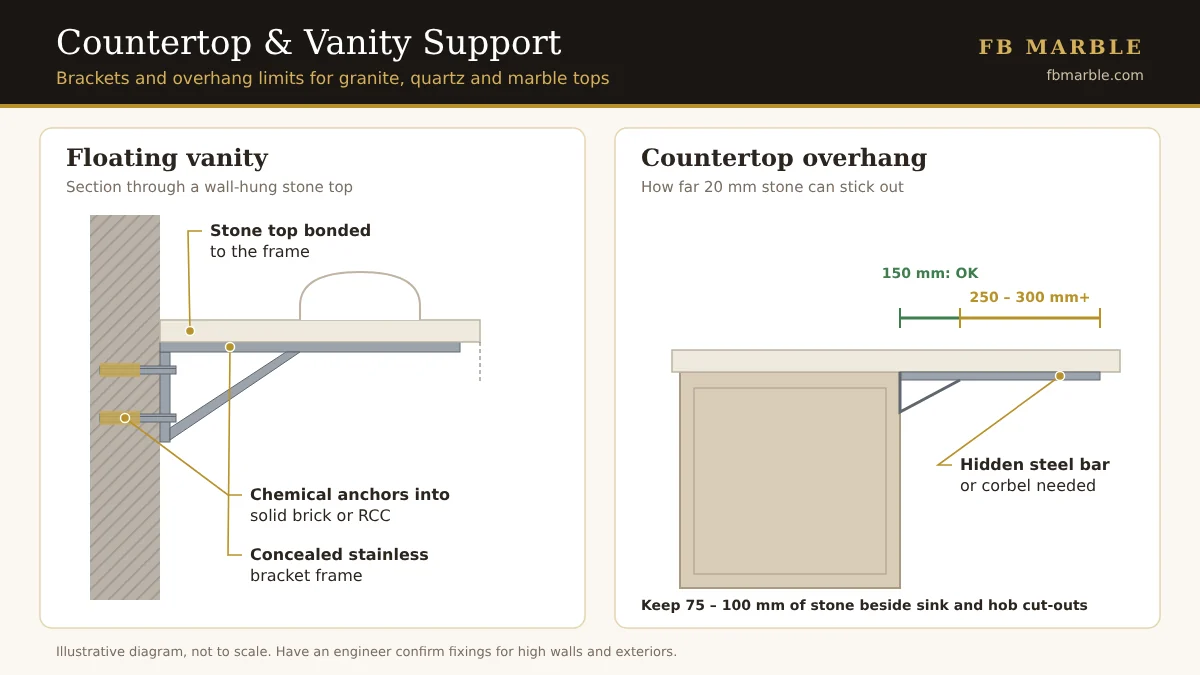
Between anchor and stone sits a bracket: usually a stainless L-angle or adjustable cladding bracket with slotted holes. The slots let the fixer move each panel a few millimetres in or out, and up or down, until joints line up perfectly. For countertops and floating vanities, hidden steel brackets do a similar job; see our countertop support guide.
Adjustment matters most on bookmatched walls, where the veins of neighbouring panels must meet, and on long elevations, where small errors add up across the width of the house.
Step 4: Pick the right stainless grade: SS 304 or SS 316?
| Grade | Where |
|---|---|
| Stainless steel 304 | Indoor walls and most inland exteriors such as Lahore |
| Stainless steel 316 | Coastal areas such as Karachi, pool surrounds, and anywhere with chlorine or salt |
Never use mild steel or ordinary iron for stone fixings. Rust expands, which cracks the stone from inside, and it leaves brown stains running down the face. Galvanised steel is also a poor long-term choice for natural stone. Insist on stainless, and check the grade marked on the hardware or the supplier's bill.
Use one grade throughout a job. Mixing stainless with other metals in the same fixing can cause corrosion where they touch, especially on exteriors that get wet in the monsoon.
Step 5: Plan joints and sealant
Leave joints of a few millimetres between panels so the stone and the building can move with heat. On exteriors, joints are either left open or filled with a non-staining silicone made for natural stone. Ordinary silicone can leave dark oily marks along the edges of marble and light granite.
Movement is real in Pakistani conditions. A west-facing elevation can heat up strongly on a summer afternoon and cool down at night. Panels butted tight together have nowhere to go, and the pressure can chip edges or push pins.
Step 6: Match the hardware to the load
Heavier panels need stronger fixings. Granite weighs about 4.5–5.5 kg per sq ft at 20 mm and 7–8 kg at 30 mm, so a large 30mm panel carries a lot more load on its pins than a small 20mm tile. Larger and thicker panels may need more anchor points, bigger pins or kerf clips instead of dowels. This is what the engineer's design decides.
Hardware at a glance
| Part | Job | Ask for |
|---|---|---|
| Wall anchor | Holds the system to the structure | Type matched to RCC, brick or block |
| Bracket or L-angle | Allows adjustment to line and level | Stainless, with slotted holes |
| Pin or clip | Holds the stone | Stainless, set in epoxy |
| Joint sealant | Closes the joint without staining | Non-staining silicone for natural stone |
Step 7: Run the checklist before fixing
- Stone thickness right for the system (usually 20mm indoors, 30mm exterior).
- All hardware stainless, correct grade for the location.
- Anchor type matched to the wall: RCC, solid brick or hollow block.
- Four fixing points per panel, two carrying load and two restraining.
- Engineer's approval for exteriors and anything above head height.
Before the first panel goes up, lay out a sample of every part on site: anchor, bracket, pin or clip, epoxy and sealant. Check each one against the list above and against the supplier's bill, so nothing is swapped for a cheaper item partway through the job.
Common mistakes
- Iron clamps or GI wire instead of stainless, which rust, expand and crack the stone.
- SS 304 on a coastal or pool job, where SS 316 is the right grade.
- Expansion anchors in brick, which can crack it.
- Anchors that stop in the plaster instead of reaching the structure.
- Holes drilled too close to the face or corner of the stone.
- Leaving pin holes empty instead of filling them with epoxy, so water collects.
- Tight joints with no room for movement in summer heat.
- Ordinary silicone that leaves oily marks on marble edges.
Read how this comes together on site in fixing marble on high walls and the elevation fixing guide.
Frequently asked questions
Which anchor is best for fixing stone on a brick wall?
A chemical (resin) anchor with a threaded stainless rod is usually best in brick. In hollow blocks, use it with a mesh sleeve. Expansion anchors can crack brick.
Should stone cladding hardware be SS 304 or SS 316?
SS 304 suits indoor and most inland exterior work. Use SS 316 near the sea, around pools and anywhere with chlorine or salt.
Can I use iron clamps or GI wire for marble?
No. Iron rusts, expands and cracks the stone, and leaves brown stains. Use stainless steel only.
What silicone should be used on marble joints?
A non-staining silicone made for natural stone. Ordinary silicone can leave dark oily marks along marble edges.
What is the difference between dowel pins and kerf clips?
Dowel pins sit in drilled holes in the stone's edges. Kerf clips sit in a continuous slot cut along the edge and spread the load better than a single pin.
Why fill pin holes with epoxy?
A stone-compatible epoxy around the pin stops water sitting in the hole, which protects both the stone and the fixing over time.
Want to see these stones in person?
Visit our showroom at Bedian Road, DHA Phase 6, Lahore, ask for free samples, or send us your measurements for a quote.