Countertop Edge Profiles Explained: Bullnose, Ogee, Bevel, Mitred and More
The edge is the part of the counter you touch and see most. A small change in profile changes the whole style of a kitchen or vanity, and how easy it is to keep clean.
When customers choose a counter, they usually spend all their time on the colour and very little on the edge. Yet the edge sets the style: a sharp square edge reads modern, a rounded bullnose feels soft and family-friendly, and an ogee looks classic and formal. You can try each one on real stones in our countertop edge visualizer.
The edge is also the part of the counter you touch and see most. It decides how easily spills wipe away, how kind the corners are to children, and how thick the counter looks. This guide explains the common profiles, how to match them to your stone, and a step-by-step way to choose.
The common edge profiles
| Edge | Shape | Style | Practical notes |
|---|---|---|---|
| Eased (straight) | Square with slightly softened corners | Modern, minimal | Simple to clean; the most common choice |
| Bevel | Angled cut on the top corner | Clean, contemporary | Less chipping than a sharp corner |
| Half bullnose | Rounded top, flat underside | Soft, versatile | Friendly for children; sheds spills |
| Full bullnose | Fully rounded top and bottom | Soft, traditional | Comfortable to lean on; thinner look |
| Ogee | S-shaped curve | Classic, formal | Decorative; more grooves to wipe |
| Dupont | Square step, then a curve below | Elegant, heavy | Looks best on thicker edges |
| Cove | Concave curve | Traditional | Pairs with classic cabinet doors |
| Mitred / waterfall | Two pieces joined at 45° | Luxury, modern | Makes a 20mm slab look much thicker |
A closer look at each family of edges
Straight and angled edges
The eased edge is a square edge with its corners lightly softened, so it does not feel sharp to the hand. It suits flat-panel and handleless cabinets and is the easiest to keep clean. The bevel adds a small angled cut on the top corner, which catches the light and is less likely to chip than a sharp corner.
Rounded edges
Half bullnose rounds the top and keeps the underside flat, so drips run off rather than pooling at the edge. Full bullnose rounds both top and bottom, which is comfortable to lean on and makes the counter look slimmer.
Decorative edges
Ogee, dupont and cove add curves and steps that suit classic kitchens, traditional cabinet doors and formal vanities. Dupont looks best on thicker edges. All three have more detail, which means more places for dust and grease to sit.
Mitred edges
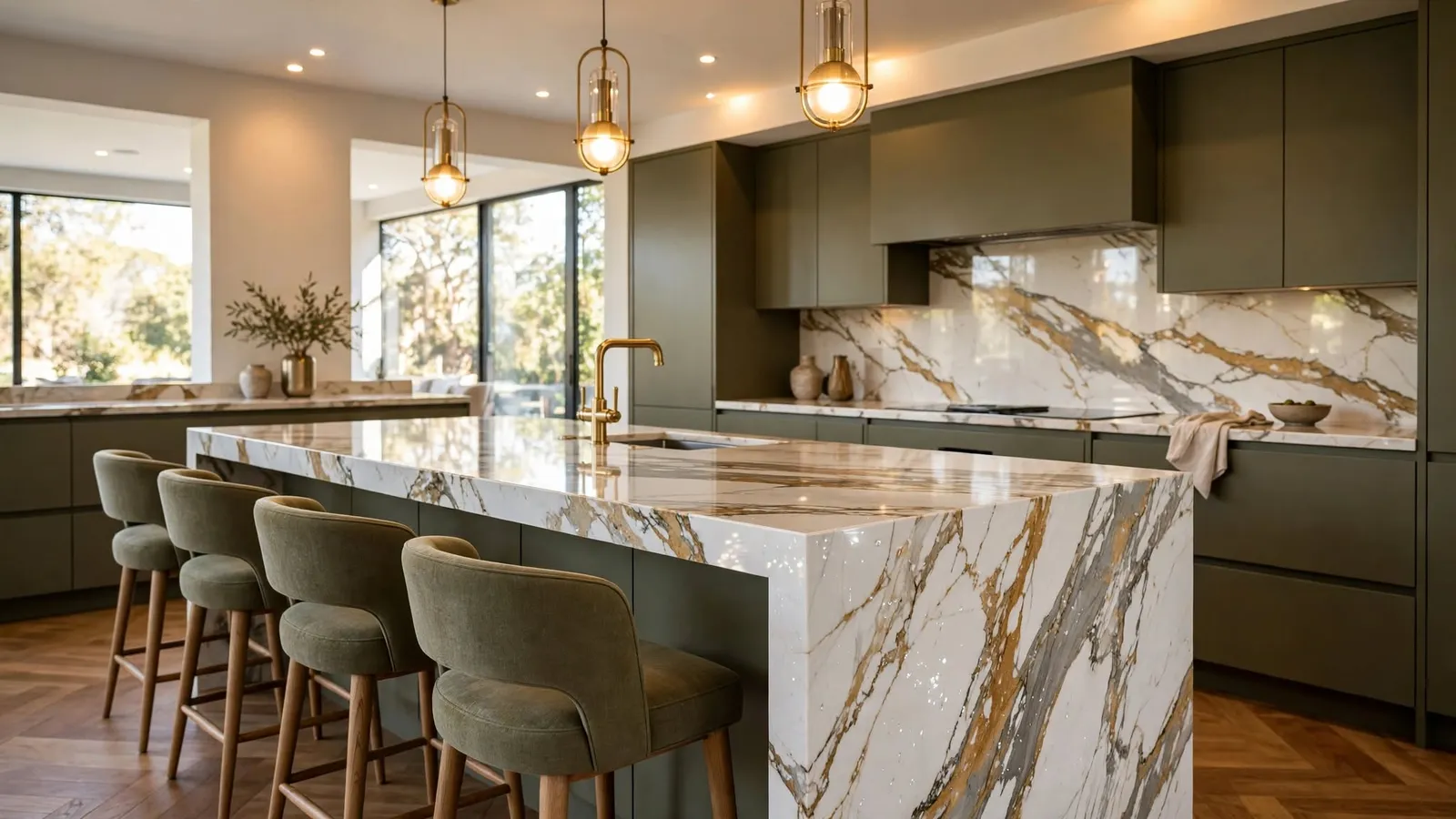
A mitred edge joins a strip of stone to the front of the counter at 45 degrees. It makes a 20mm slab look much thicker without the weight and cost of a full 30mm slab, and it is the edge used for waterfall islands.
Match the edge to the stone
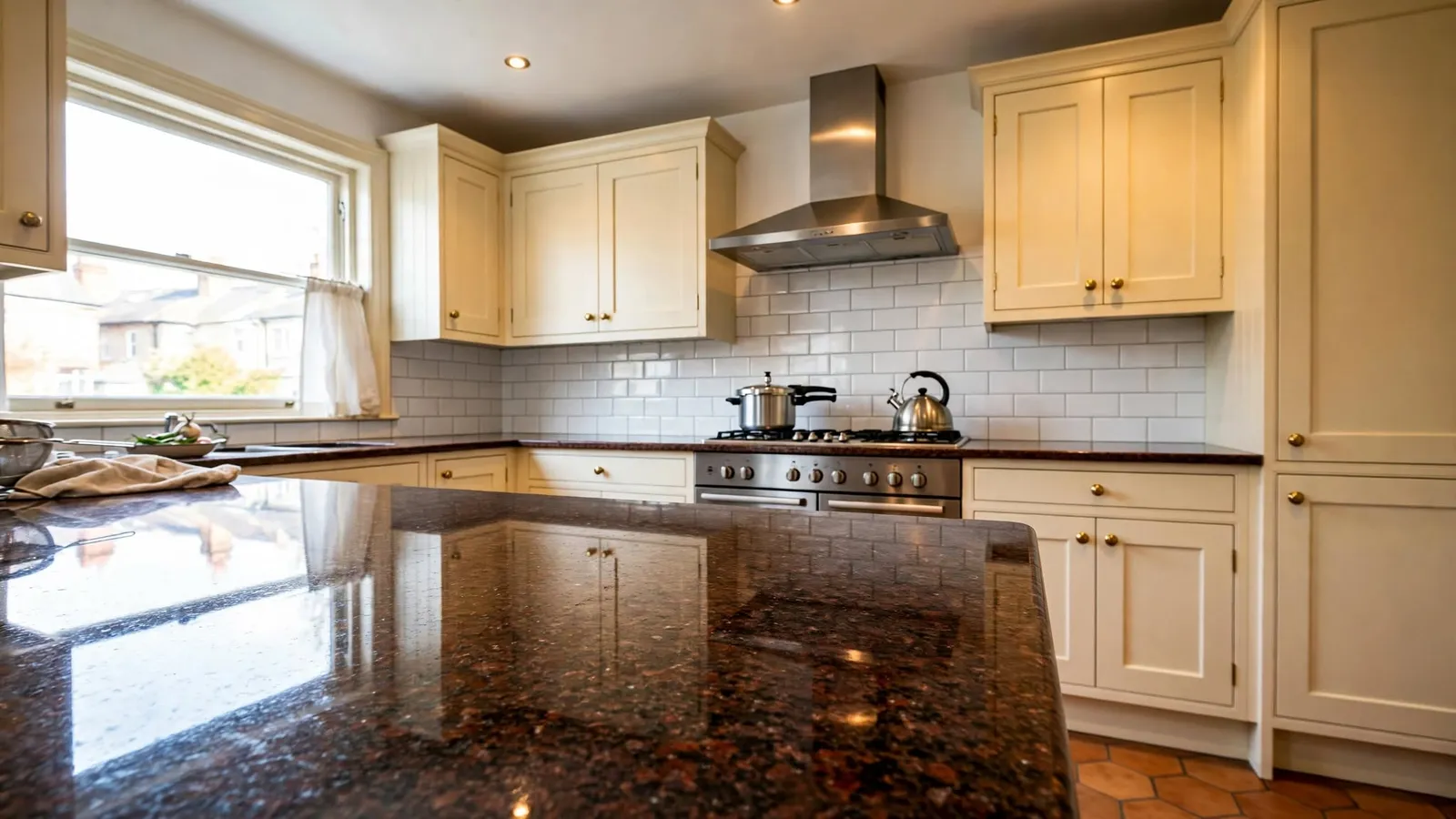
- Busy granites like Tan Brown or Brown Fantasy already have lots of movement; a simple eased or half-bullnose edge keeps the look calm.
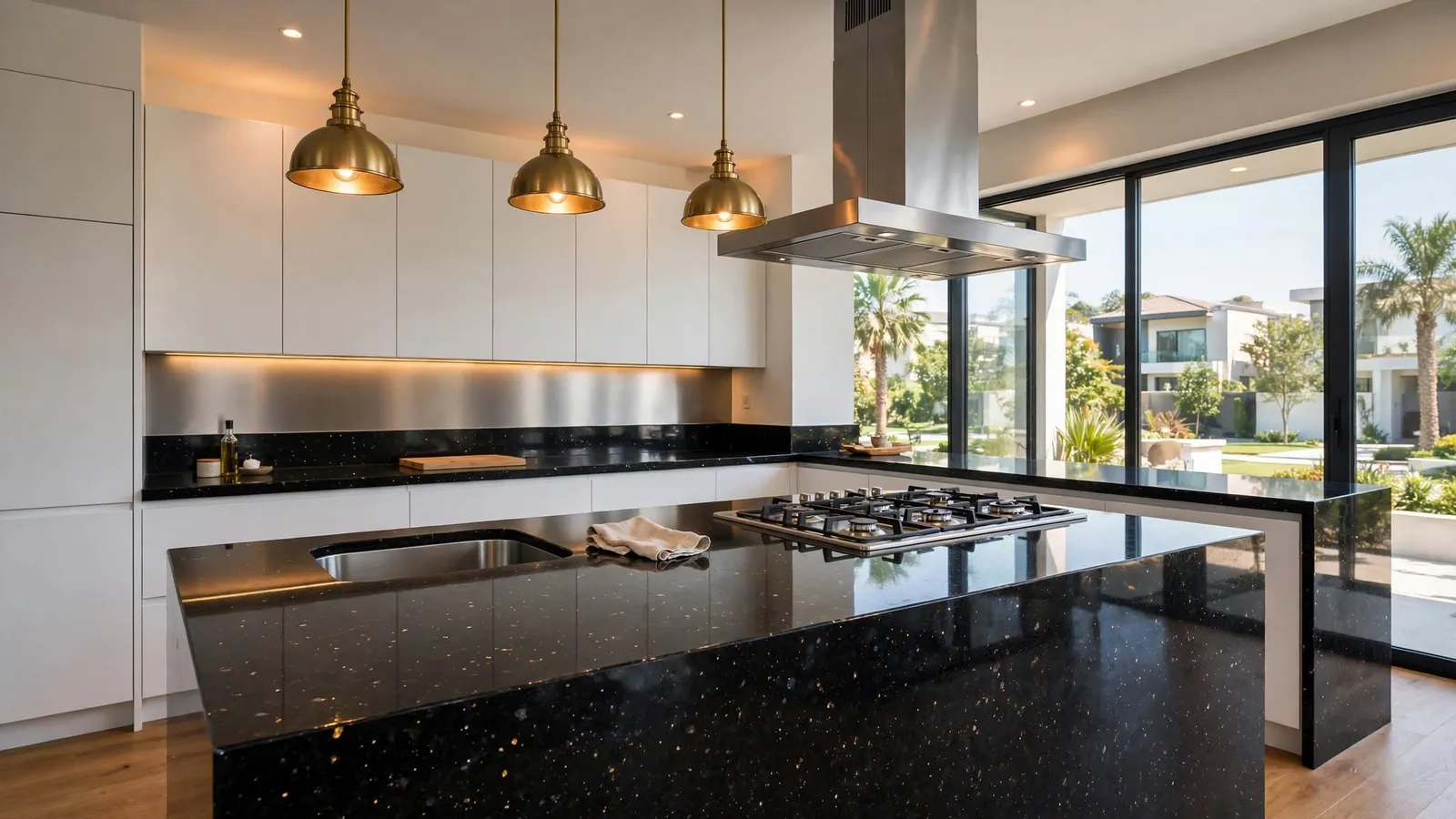
- Plain darks like Titanium Black show off a detailed edge such as ogee or dupont.
- Veined quartz and marble like Calacatta Gold look best with mitred edges, so the veins wrap around the corner.
- Porcelain slabs usually need mitred edges, because the pattern does not run through the body. See porcelain vs marble.
What you need to choose an edge
- your chosen stone, or a shortlist of two or three
- a cabinet door sample, to match the style of the edge
- your counter thickness: 18mm, 20mm or 30mm where available
- a note of who uses the kitchen, including small children
- a list of every exposed edge: counter fronts, island sides, breakfast bar and window sills
Choosing your edge: step by step
Step 1: Start with your cabinets
Flat, handleless or modern cabinets suit eased, bevel or mitred edges. Shaker-style or classic panelled doors suit half bullnose, ogee, cove or dupont. Hold the cabinet sample next to an edge sample to check the match.
Step 2: Think about who uses the kitchen
For homes with small children, rounded profiles like half or full bullnose are kinder on heads and hips. The same applies to islands and breakfast bars in a busy family kitchen, where people walk past the corners all day.
Step 3: Consider how you cook
A desi kitchen sees tadka, frying in ghee and haldi most days. If you cook a lot, avoid very deep grooves near the hob, because oil and masala collect in them. Keep the decorative edge for the island or dining side and use a simpler edge on the cooking run.
Step 4: Match the edge to the stone
Calm the look of a busy granite with a simple edge, show off a plain dark stone with a detailed one, and use mitred edges for veined quartz, marble and porcelain.
Step 5: Decide on thickness
If you want a heavy, thick look, a mitred edge on a 20mm slab gives it without the extra weight of a 30mm slab. Granite weighs about 4.5–5.5 kg per sq ft at 20 mm and about 7–8 kg at 30 mm, so this also matters for the cabinets underneath.
Step 6: See it on your stone
Try the edge on your chosen stone in our visualizer, or ask to see sample edges at the showroom before confirming.
Safety and cleaning
For homes with small children, rounded profiles like half or full bullnose are kinder on heads and hips. If you cook a lot, avoid very deep grooves near the hob, because oil and masala collect in them. An eased or bevel edge is easiest to wipe.
Clean edges with a soft cloth and a pH-neutral cleaner, the same as the counter top. Hard water drips often run over the front edge near the sink and dry as white marks, especially on dark polished stone, so give that area a quick wipe dry after washing up. On marble, acids such as lemon and vinegar etch the edge as easily as the top.
Common mistakes
- Choosing the edge last. The edge changes the style and the quote, so decide it with the stone, not after.
- A deep ogee next to the hob. Oil and masala gather in the grooves. Use a simpler edge on the cooking run.
- Sharp square corners in a family kitchen. Rounded edges are kinder to children.
- A profiled edge on porcelain. The plain body shows. Porcelain usually needs a mitred edge.
- A busy edge on a busy stone. A strongly patterned granite looks calmer with a simple edge.
- Not listing the edge on the quote. Ask for it separately so you can compare suppliers fairly.
Does the edge change the price?
Yes, a little. Simple eased and bevel edges are standard. Shaped edges like ogee and dupont take more machine and polishing time, and mitred edges need extra stone for the front strip. Ask for the edge to be listed separately on your quote so you can compare. Our granite price guide explains other costs to check.
For a closer look at granite-specific edges, see granite edge designs.
Stones in this guide
 Tan Brown GraniteFrom Rs 1,400 / sq ft
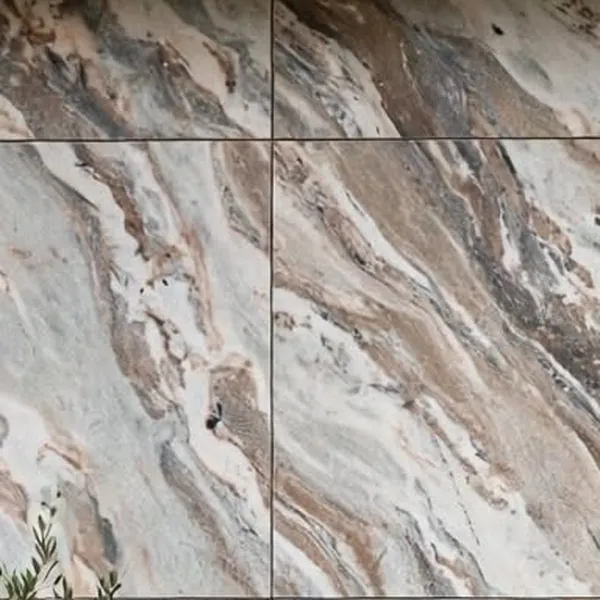 Brown Fantasy GraniteFrom Rs 2,800 / sq ft
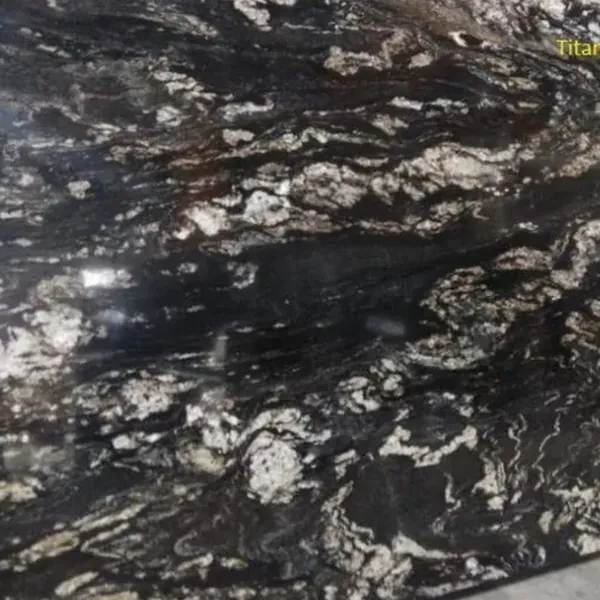 Titanium Black GraniteFrom Rs 2,500 / sq ft
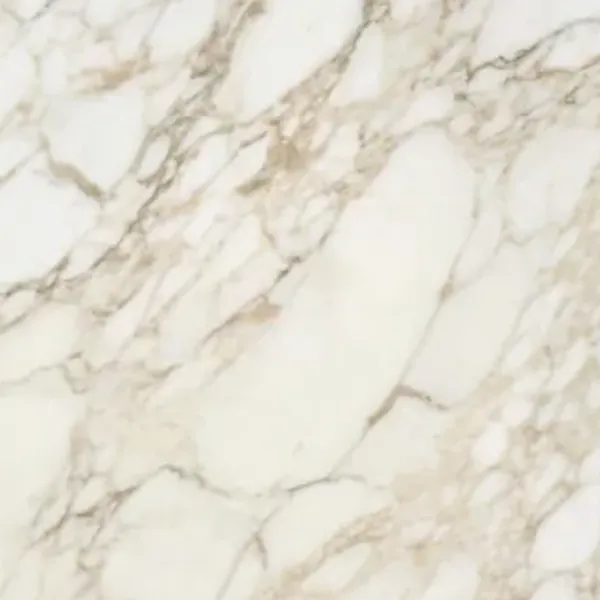 Calacatta Gold QuartzFrom Rs 1,350 / sq ft
Estimated rates per square foot for the slab only, as listed on each stone's page. Rates move with stock and import costs, so confirm today's price on WhatsApp.
Frequently asked questions
Which countertop edge is most popular?
The eased (straight) edge is the most common choice for modern kitchens. Half bullnose is popular for family homes because it is rounded and safer.
What is a mitred edge?
A mitred edge joins a strip of stone to the front of the counter at 45 degrees, making a 20mm slab look much thicker. It is also used for waterfall islands.
Which edge is safest for children?
Rounded profiles such as half bullnose or full bullnose have no sharp corners and are the safest choice.
Can I see edges on my chosen stone before ordering?
Yes. Use our countertop edge visualizer online, or ask to see sample edges at the showroom.
Which edge is easiest to clean?
An eased or bevel edge is easiest to wipe. Decorative edges such as ogee have grooves where oil and masala can collect.
Which edge suits porcelain slabs?
Porcelain usually needs a mitred edge, because the pattern does not run through the body. See porcelain vs marble.
Want to see these stones in person?
Visit our showroom at Bedian Road, DHA Phase 6, Lahore, ask for free samples, or send us your measurements for a quote.