Damaged Granite: When to Repair Chips, Cracks and Stains, and When to Replace the Piece
Most granite damage looks worse than it is. Chips, stains and dull patches can usually be repaired. But some cracks are a warning sign, and patching them only hides a bigger problem.
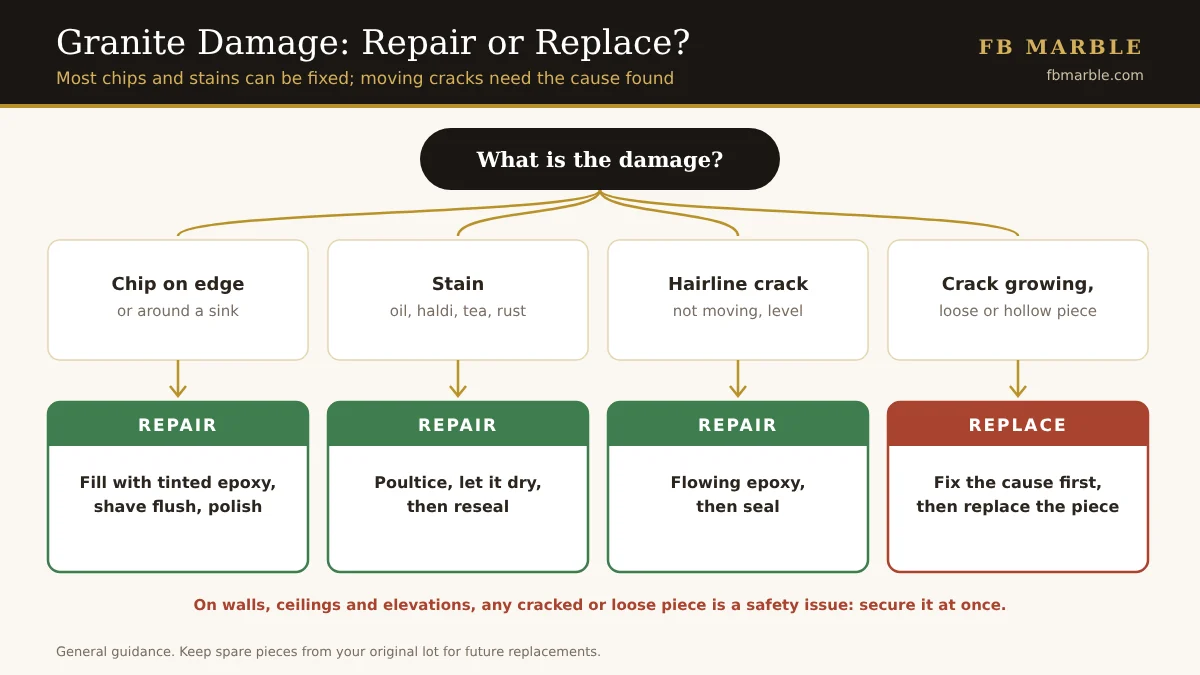
Before you call anyone, look closely at the damage and answer three questions: Is the piece loose or moving? Is the crack getting longer? Is it a stain on the surface or something inside the stone? The answers decide the fix.
Granite is hard and long-lasting, so most damage is local: a chipped edge where a pateela was knocked against the counter, an oil mark beside the hob, a dull patch where hard water has dried for months. These can usually be repaired so they are hard to find. A few kinds of damage are different. They point to a problem underneath the stone, and repairing the surface only hides it for a while. This guide shows you how to tell them apart, step by step.
What you need to assess the damage
- Good daylight, or a torch held low across the surface.
- A pencil or a strip of tape to mark the ends of any crack.
- A straight edge or spirit level to check whether one side has dropped.
- A coin or a wooden handle to tap floor tiles for hollow spots.
- A phone camera to photograph the damage and any spare pieces.
Step 1: Check whether the piece is loose or moving
Press firmly on either side of the damage. On a counter, lean on the overhang and the front edge near the sink. On a floor, tap the tile and the ones around it. Any rocking, creaking or hollow sound means the support underneath has failed. That has to be fixed before any surface repair will last.
Step 2: Deal with chips
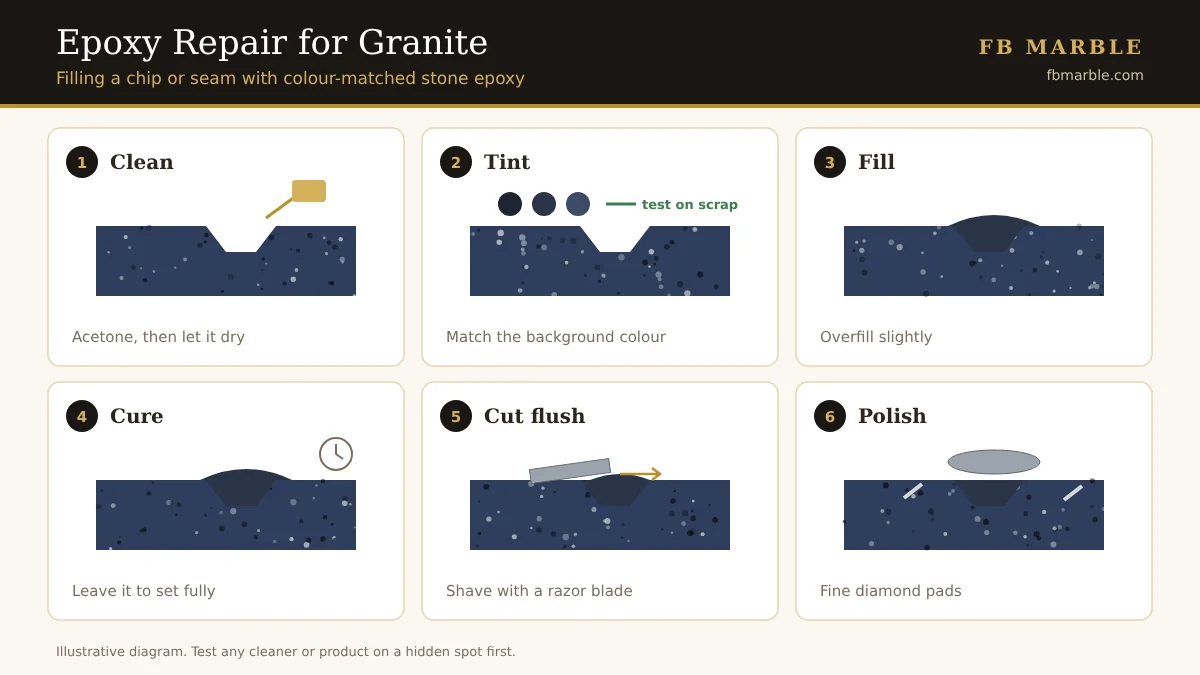
Small chips on edges and around sinks are the most common damage. They are easy to fill with colour-matched epoxy, shaved flush and polished. If you have the broken piece, it can often be glued back. Large missing corners on a front edge can be rebuilt, but on light stones the repair may show; replacing a short section of edge or the whole piece is sometimes neater. The method is in our epoxy guide.

Keep any broken piece in a safe place until the repair is done. A chip glued back into place usually looks better than a fill, because the pattern and colour already match.
Step 3: Judge the crack
| What you see | Likely cause | What to do |
|---|---|---|
| Fine hairline, not moving, surface level | Natural fissure or old stress | Fill with flowing epoxy and seal |
| Crack beside a sink or hob cut-out | Thin stone strip, sharp corners, poor support | Add support underneath, then epoxy; replace if it opens |
| Crack that grows or one side is lower | Movement in the base, cabinet or floor slab | Fix the cause first, then replace the piece |
| Cracked floor tile that sounds hollow | Air pockets under the tile | Lift and relay on a full bed |
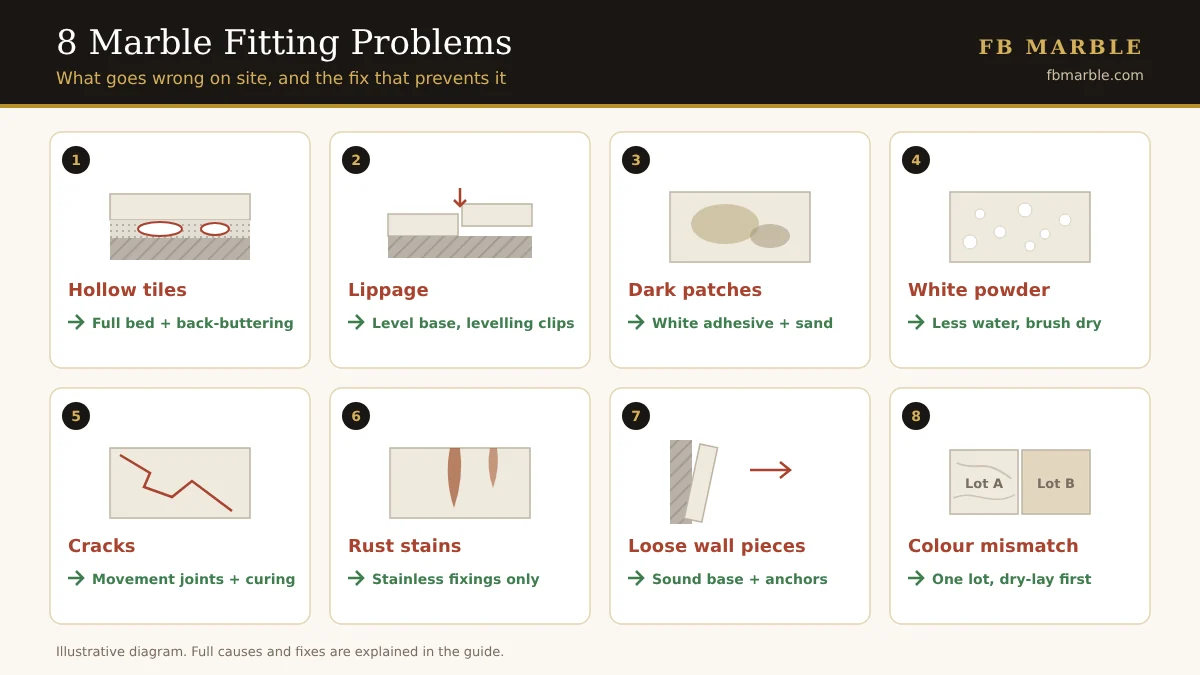
On walls, ceilings and elevations, any cracked or loose piece is a safety issue. Have it secured or removed straight away; see fitting problems and solutions.
To find out whether a crack is growing, mark both ends with a fine pencil line and the date, then look again after a few weeks. If the crack has passed the marks, something is still moving. Run a straight edge across it too: if one side sits lower than the other, the stone is no longer supported evenly.
Many natural granites contain fine fissures from the quarry. They are part of the stone, not damage, and they are usually filled at the factory. Do not confuse them with a fresh crack that runs from a cut-out corner or a joint.
Step 4: Treat the stain
- Oil and ghee: a poultice of baking soda and a little acetone or water, covered with plastic for a day, draws the oil out. Repeat if needed.
- Tea, coffee, haldi: a poultice with a little hydrogen peroxide on light granites. Test on a hidden spot first.
- Rust: a specialist stone rust remover; ordinary rust removers are acids that can damage polish and resin.
- Water rings and dull patches: usually mineral deposits or a worn surface. Clean with a neutral cleaner; if that does not work, re-polish.
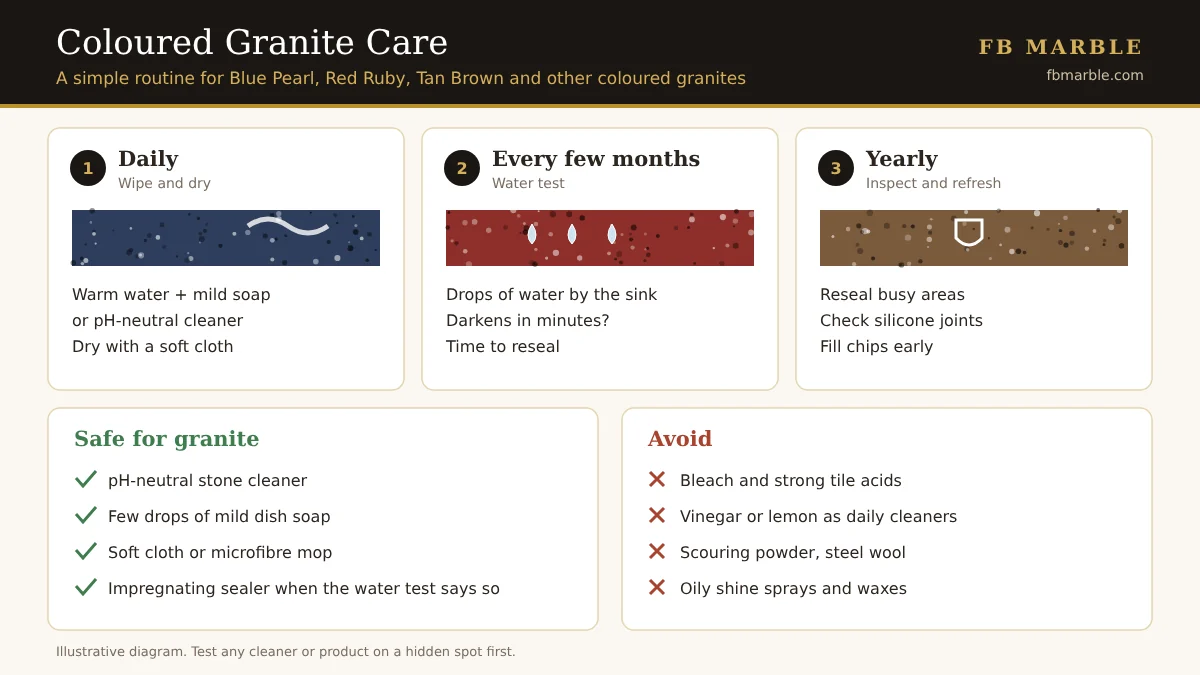
After any stain removal, let the stone dry and reseal it.

Make the poultice into a thick paste, about the consistency of yoghurt, and spread it a little beyond the edge of the stain. Tape the plastic down at the edges so it does not dry out too fast. Do not scrub at a stain with scouring powder or steel wool; it scratches the polish and does not reach oil that has soaked in.
A stain that is darker when the stone is wet and fades as it dries is usually water, not oil, and often disappears on its own once the stone dries fully.
Step 5: Decide whether to repair or replace
When replacing is the better choice
- The piece is broken through, loose, or one side has dropped.
- The same area keeps cracking after repair.
- A large corner or edge is missing on a light stone where any repair would show.
- A floor tile is hollow and cracked; it will keep failing until it is relaid.
Before a replacement piece goes in, fix whatever caused the damage. That might mean levelling a cabinet, adding a steel strip across a gap, repairing a leaking pipe under the floor, or relaying the bed under a hollow tile. Otherwise the new piece will fail in the same way.
Repair or replace at a glance
| Damage | Usually |
|---|---|
| Small chip | Repair with epoxy |
| Large missing corner on light stone | Replace the section or piece |
| Fine, stable hairline crack | Repair with flowing epoxy and seal |
| Growing crack, or one side lower | Fix the cause, then replace |
| Oil, tea or haldi stain | Poultice, then reseal |
| Dull patches and water rings | Neutral clean, or re-polish |
| Hollow, cracked floor tile | Lift and relay on a full bed |
Common mistakes
- Filling a crack that is still moving. It will reopen, often wider.
- Using ordinary rust remover. Most are acids that damage polish and resin.
- Scrubbing stains with abrasives. It scratches the surface and leaves the stain.
- Forgetting to reseal after a poultice or a repair.
- Leaving a cracked wall or elevation piece in place. Secure or remove it at once.
- Replacing a piece without fixing the cause. The new piece cracks too.
Matching a replacement piece
Matching an old floor or counter is easiest if you kept a few spare pieces from the same lot. If not, send us a clear photo in daylight on WhatsApp; natural stone varies by lot, so we will show you the closest current match before cutting. To work out the size you need, use our square-feet guide.
Frequently asked questions
Can a cracked granite countertop be repaired?
Fine, stable hairline cracks can be filled with epoxy and sealed. Cracks that grow or where one side has dropped need the cause fixed and the piece replaced.
How do I remove an oil stain from granite?
Apply a poultice of baking soda with a little acetone or water, cover it with plastic for about a day, then remove and repeat if needed. Reseal afterwards.
When should a granite floor tile be replaced?
When it is cracked and hollow, broken through, or keeps cracking after repair. Relay it on a full bed of adhesive.
Can you match new granite to an old installation?
Often closely, but stone varies by lot. Keep spare pieces from the original order; otherwise send a daylight photo so the closest match can be found.
How can I tell if a crack in granite is getting worse?
Mark both ends with a pencil line and the date, then check again after a few weeks. If the crack has passed the marks, or one side is lower, something is still moving.
How do I get haldi out of light granite?
Use a poultice with a little hydrogen peroxide, tested on a hidden spot first, then let the stone dry and reseal it.
Want to see these stones in person?
Visit our showroom at Bedian Road, DHA Phase 6, Lahore, ask for free samples, or send us your measurements for a quote.